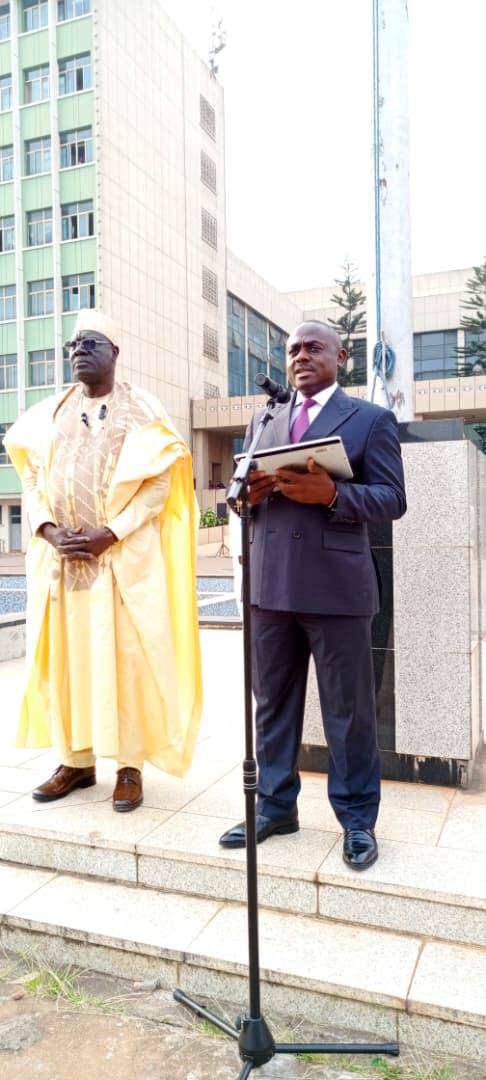
Flag-Raising Ceremony and Civic Minute on the Forum Theme and Challenges
Yaoundé, Wednesday 14 January 2026 — Activities of the National Youth Forum officially began at the Yaoundé Conference Centre with a solemn sequence combining a flag-raising ceremony and the Civic Minute, dedicated to the theme and key challenges of the Forum.
Upon his arrival at the Conference Centre, the Minister of Youth and Civic Education, MOUNOUNA FOUTSOU, was received by the Secretary-General, Robert Théophile BENGA, in a protocol setting consistent with the importance of this opening day.
Beyond this ceremonial sequence, the Minister was scheduled to preside, both in person and via videoconference, over the official opening of the conference of heads of central, decentralized, attached and supervised services under the Ministry of Youth and Civic Education. Later in the same day, he was also expected to receive New Year’s greetings.
A solemn patriotic ceremony led by BTAP-trained personnel
The opening of the day was marked by a disciplined and highly symbolic flag-raising ceremony. In a ritual they master with professionalism, MINJEC personnel trained at the Koutaba Airborne Troops Battalion (BTAP), within the framework of the Specialized Higher Military Preparation programme, conducted the raising of the national flag and rendered full honours to it.
The ceremony was conducted under the command of Reserve Officer NGAH Guillaume (Class of 2019), assisted by Reserve Officers Nsangou NJIKAM AHMAD and OUMAROU YAOUBA (2024 contingent).
The Minister’s opening message: purpose, vision and expected outcomes
In his first address of the day, the Minister recalled the rationale for convening the National Youth Forum and the responsibility it carries. He explained that the Forum is designed to set up a strategic, inclusive and multisectoral national consultation framework capable of producing sustainable and coordinated solutions to the present and future challenges faced by Cameroonian youth.
“This Forum is being organized to establish a national framework for strategic and inclusive consultation, in order to provide durable, coordinated and multisectoral responses to the challenges of our youth,” the Minister stated.
He further stressed that the expected outcomes of the Forum must translate into tangible progress in the areas of human capital development, promotion of decent employment, participatory governance and social cohesion.
The Minister also underlined that this initiative aligns with the High Instructions of the President of the Republic, Head of State, His Excellency Paul Biya, who has placed young people and women at the heart of the Septennat of Great Expectations.
“In keeping with the High Instructions of the Head of State, our youth and women are at the centre of the Septennat of Great Expectations. This Forum must contribute directly to that national ambition,” he emphasized.
He concluded by noting that the Forum will unfold through several activities hosted at the Conference Centre, all designed to strengthen coordination, inclusiveness and national ownership of youth-focused priorities.
Civic Minute: Ethics and Administrative Deontology
The Civic Minute of the day focused on “Ethics and Administrative Deontology” and was led by the Inspector General of Services, Dr Éric AKEDE METOUGUE.
In an address centred on discipline, accountability and the values of public service, he first deplored certain attitudes that weaken institutional performance, notably laxity and lateness. He described the moment as one of reflection, cohesion and recommitment.
“This is a day of celebration for me,” he declared, while calling on public servants to renew their commitment to professionalism and duty.
He clarified that ethics refers to moral values, good judgement and human principles, whereas deontology refers to the set of rules that govern a profession or a professional body.
He emphasized that administrative action must be guided by the following core values:
-
Quality work, punctuality and diligence
-
Selfless public service and user satisfaction
-
Moral integrity, especially through the fight against corruption
He also recalled the foundations of administrative deontology:
-
The obligation to serve
-
Respect for hierarchy
-
Responsibility
-
Dignity
-
Equity and neutrality
-
Continuity of public service
-
Loyalty
-
Adaptability and professional confidentiality
He concluded by stressing that ethics and deontology are not abstract concepts but daily obligations that determine citizens’ trust in public institutions.