Official Presentation of the National Youth Policy and the Youth Plan
This phase opened with the official presentation of the National Youth Policy and the Youth Plan, delivered by Dr. KUN IV José, Assistant Inspector of Pedagogy No. 3 (IAP3) and Chairperson of the relevant commission.
In his presentation, it was emphasized that the Youth Plan is the concrete operational tool that translates the National Youth Policy into action. It provides a practical framework for implementation and is structured around several major sectors, namely:
-
Education and Training, aimed at improving youth education for inclusive training and employability;
-
Employment and Socio-Economic Integration of Youth, focused on promoting self-employment and integrating young people into value chains;
-
Promotion of Youth Participation in public life and decision-making processes;
-
Governance and Institutional Support, ensuring coherence, coordination, and effectiveness of youth policies.
Defining the Youth Plan
The Youth Plan represents the practical integration of the youth-centered approach by all stakeholders involved in youth-related issues. It is a formal document that operationalizes the axes and actions of the National Youth Policy by translating them into concrete activities.
It also ensures that various public administrations align their sectoral actions with the priorities defined by the National Youth Policy, thereby fostering coherence, accountability, and measurable impact.
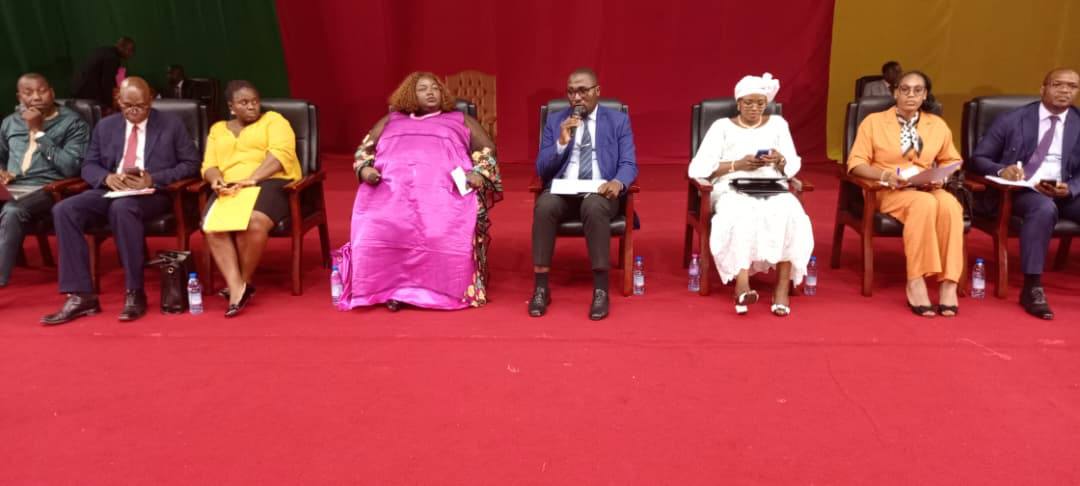
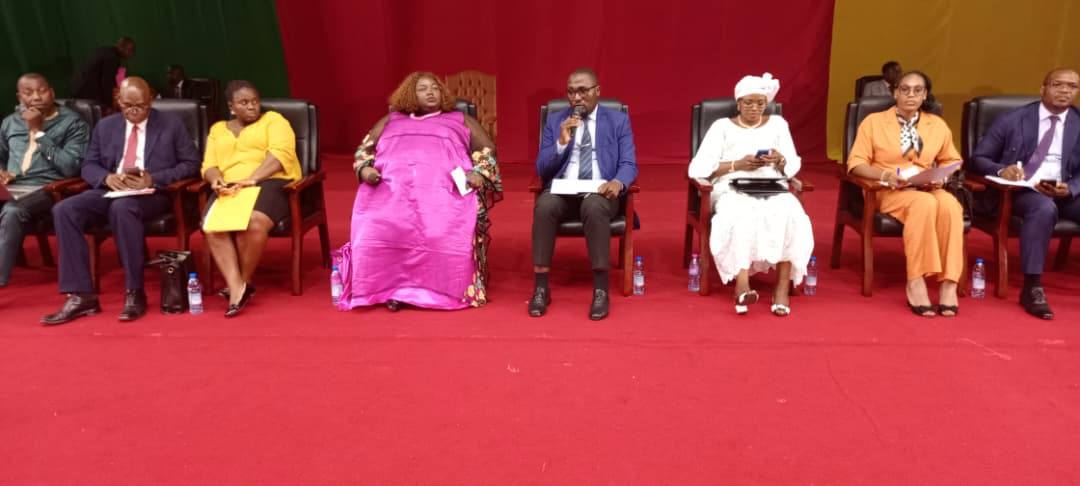
PANEL 1: EDUCATION AND TRAINING
This panel focused on the missions and perspectives of sectoral ministries that support youth on a daily basis, particularly in the fields of education and training.
The ministries concerned included:
-
Ministry of Basic Education;
-
Ministry of Secondary Education;
-
Ministry of Higher Education;
-
Ministry of Youth and Civic Education;
-
Ministry of Employment and Vocational Training;
-
Other related ministerial departments.
The moderation of this panel was ensured by Professor Wilfred GABSA, Secretary General at the Ministry of Higher Education.
Actions of the Ministry of Higher Education in Favour of Youth
In his address, Gustave Raoul NKOUÉ NDONDO, Head of the Statistics Unit at the Ministry of Higher Education, presented the actions undertaken in support of youth.
He highlighted that the Ministry acts through:
-
the improvement of university infrastructure;
-
the strengthening of employability through better alignment between training and employment;
-
the promotion of entrepreneurship through interministerial circulars in collaboration with the Ministry of Youth and Civic Education;
-
support for innovation and youth-led enterprises through State subsidies;
-
the improvement of students’ living and study conditions.
A major innovation is the establishment of the National Observatory of Professions for Higher Education Graduates (OMDES), which collects and disseminates job offers and provides training in job-search techniques.
The Ministry also promotes youth training in employability skills, high-potential professions, and entrepreneurial mindset development. Innovation is encouraged through support to Junior Enterprises, backed by State subsidies.
Presentation by the Ministry of Youth and Civic Education: Missions and Strategic Axes
This presentation was delivered by Maha Hadja OUZA Epse IBRAHIM, Director of Civic Education and National Integration at the Ministry of Youth and Civic Education.
She explained that the Ministry is responsible for developing strategies aimed at youth empowerment, civic and moral education, socio-economic integration, and the promotion of values such as peace and solidarity.
Its strategic axes focus on:
-
strengthening youth capacities;
-
developing youth supervision infrastructures;
-
promoting youth entrepreneurship;
-
encouraging citizen participation and national integration;
-
integrating digital tools, including artificial intelligence, for transformation.
The Ministry acts as a facilitator of youth contribution to national development, promoting values of peace, work, democracy, and solidarity.
Training Opportunities Offered by the Ministry of Livestock, Fisheries and Animal Industries
The Ministry offers several training programmes to support youth and professionals in livestock, fisheries, and animal industries, including:
Initial Training
Targeted at young people and future professionals through institutions such as:
-
Limbe Nautical Arts and Fisheries Institute (LINAFI);
-
National Zootechnical and Veterinary Training Centres (CNFZV) in Foumban, Jakiri, and Maroua;
-
Agropastoral Operators Training Centres.
Professional Training
Dedicated to farmers, fishers, and breeders already in activity, aimed at strengthening skills and adopting innovative and sustainable practices.
Entrepreneurship Training
Designed to support youth in creating and managing businesses in livestock and aquaculture sectors.
Business Management Training
Provided under the Livestock and Fisheries Value Chain Development Project (PDCVEP), focusing on improving enterprise management.
These programmes aim to enhance youth employability and stimulate rural economic development.
The Ministry of Employment and Vocational Training: A Strategic Lever for Youth Employability
The Ministry of Employment and Vocational Training implements government policy on employment promotion and vocational training through several initiatives, including:
-
“One Youth, One Skill, One Job” (JEME) Programme, with a budget of 17.720 billion FCFA;
-
1,800 vocational training scholarships in sectors such as ICT, management, audiovisual production, and beauty care;
-
Entrepreneurship support, including innovation and creativity promotion through the GETEC 2025;
-
Vocational training in agriculture, food processing, and manufacturing;
-
Partnership development with enterprises and organizations to provide practical training and employment opportunities.
Adopting a Realistic Understanding of One’s Environment
In response to participants’ questions, Robert Théophile BENGA, Secretary General, encouraged young people to develop a realistic understanding of their environment and to seize all opportunities offered by public services in terms of guidance, support, and accompaniment.
He emphasized that youth empowerment requires both ambition and a clear awareness of available institutional mechanisms.