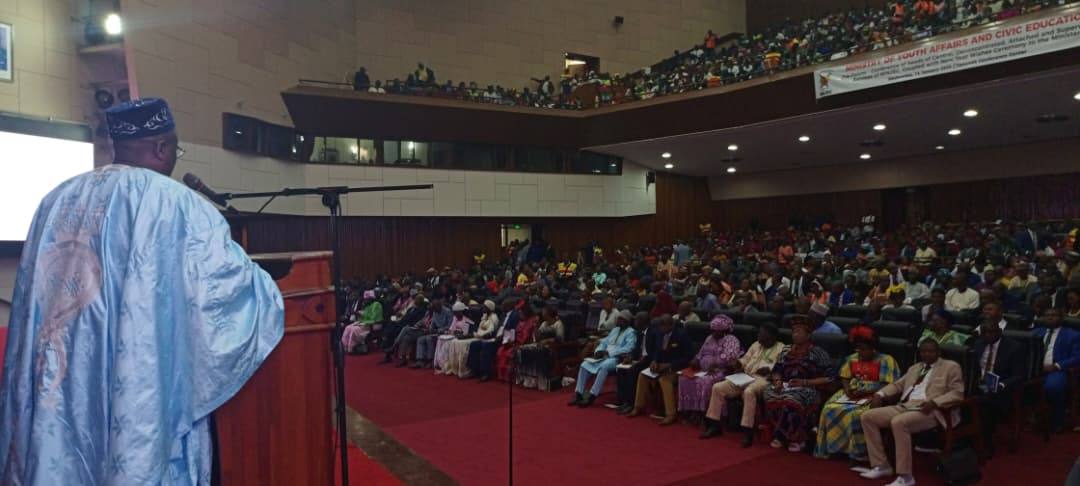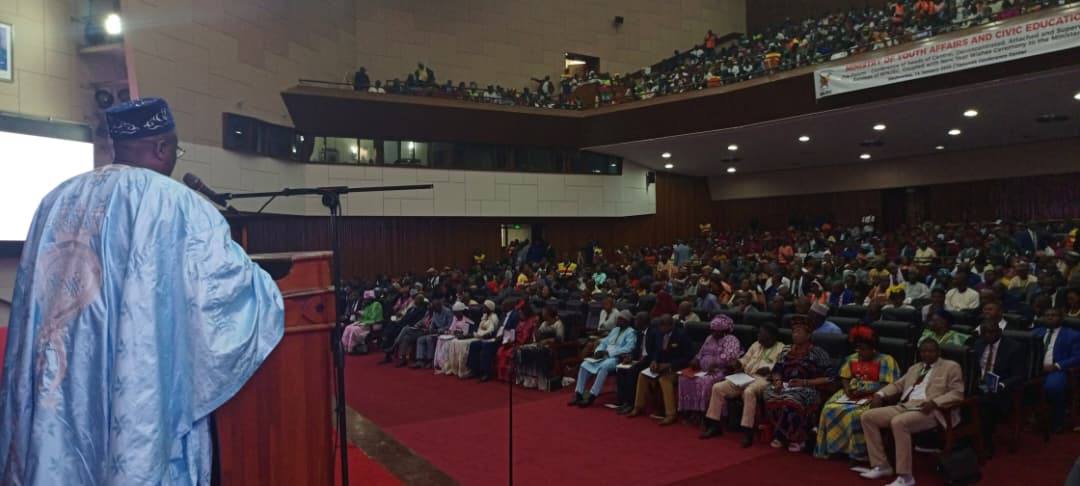
Moderator: Robert Théophile BENGA, Secretary-General at the Ministry of Youth and Civic Education
The second panel of the Conference of Heads of Central, Decentralized, Attached and Supervised Services was devoted to cross-cutting thematic issues, which form the backbone of the national youth policy architecture. Moderated by the Secretary-General of the Ministry of Youth and Civic Education, Robert Théophile BENGA, this panel aimed to establish a shared analytical framework for the technical discussions that followed.
National Youth Policy and Youth Plan
To open this phase of the Conference, the Secretary-General presented the National Youth Policy and the Youth Plan, highlighting the context of their creation, the motivations behind their development, and the strategic logic that underpins them.
In his presentation, he explained that these instruments were designed to provide Cameroon with a coherent and structured response to the multidimensional challenges facing young people, including education, employment, civic participation, social inclusion, and national cohesion.
He detailed the key levers mobilized to achieve the objectives set out in these frameworks, the constraints encountered in their implementation, the actors involved at national and local levels, as well as the achievements recorded so far and the future perspectives.
“The National Youth Policy and the Youth Plan are not static documents; they are living instruments that evolve with the realities and aspirations of our youth,” he emphasized.
This presentation served as a conceptual and operational grounding for the subsequent technical exchanges.
National Action Plan on Youth, Peace and Security
Following the Secretary-General’s intervention, participants listened to a presentation on the National Action Plan on Youth, Peace and Security, delivered by ACHA LEKE Christian.
In his exposition, he emphasized the strategic importance of integrating young people into peacebuilding, conflict prevention, social cohesion, and national stability mechanisms. He stressed that youth are not merely beneficiaries of peace, but active agents of transformation and resilience.
“Peace cannot be sustained without the meaningful participation of young people in decision-making, mediation, and community engagement processes,” he noted.
He further outlined the operational pillars of the Plan, its implementation mechanisms, and the expected outcomes in terms of youth leadership, civic engagement, and social responsibility.
Some detailed explanations of the National Action Plan on Youth, Peace and Security can be found in the official Forum documents.
Special Youth Triennial Plan and Youth Entrepreneurship Promotion Plan
The discussion then moved to the Special Youth Triennial Plan (PTS-Jeunes) and the Special Youth Entrepreneurship Promotion Plan, both instituted by the Head of State.
On this subject, ABDOUL-KARIM NASSOUROU, Director of Youth Economic Promotion at the Ministry, presented key insights and statistical highlights, offering participants a clearer understanding of the scale, scope, and ambition of these initiatives.
He provided figures illustrating the volume of beneficiaries targeted, the sectors prioritized, and the expected socio-economic impact of these programmes.
“These plans aim to place young people at the centre of the productive system, not only as job seekers but as job creators,” he explained.
His presentation underscored the importance of sustainability, access to financing, capacity building, and mentorship as critical success factors.
The Imperative of Data Integrity and Evidence-Based Decision-Making
The final segment of Panel 2 focused on the importance of reliable and systematic data collection for informed strategic decision-making in the youth sector.
This presentation was delivered by Dr Bienvenu HABIT, Head of the Division of Cooperation and Statistics at the Ministry.
He addressed the theme of “Statistical Data Collection: Needs and Methods for Systematic Data Gathering”, emphasizing that sound youth policies must be built on accurate, verifiable, and up-to-date data.
He warned against the dangers of fragmented, inconsistent, or politically biased data, which can lead to poor planning, misallocation of resources, and ineffective interventions.
“Without reliable data, we do not govern; we guess,” he cautioned.
He then outlined the methodological approaches required for systematic data collection, the institutional frameworks needed to support it, and the role of intersectoral collaboration in strengthening the national youth information system.
He concluded by stressing that data sincerity is not merely a technical requirement but an ethical obligation toward young people and the nation.