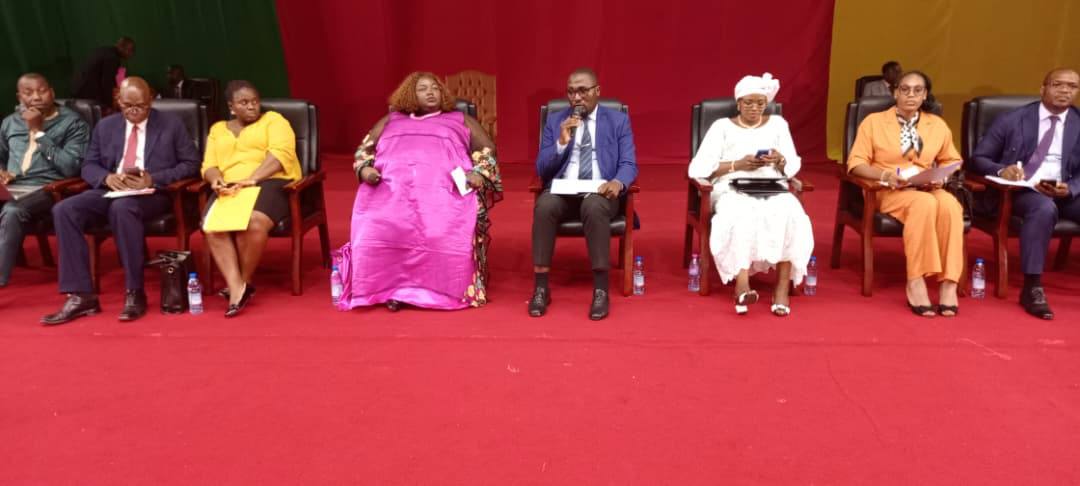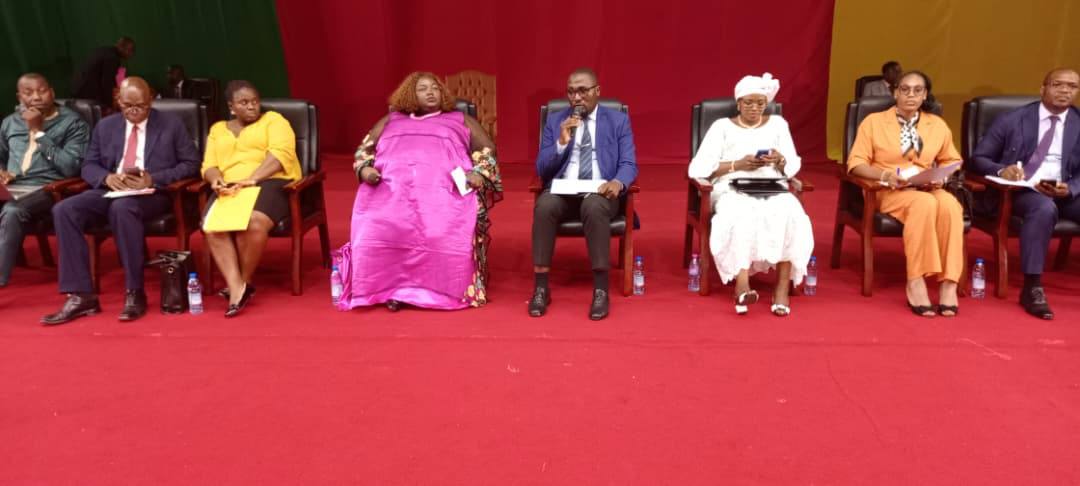
Panel 2 of the National Youth Forum was devoted to the theme of economic empowerment and youth employability, a central priority of public policies aimed at reducing unemployment and promoting inclusive and sustainable development.
The panel was moderated by Siegfried MENGOUNG, Head of the Department of Civic Education and National Integration at the National Institute of Youth and Sports (INJS), and Fidèle DJEBBA, President of the National Council of Popular Education (CONEP). In their introductory remarks, the moderators emphasized that sustainable youth employability requires a multisectoral, inclusive, and market-oriented approach.
Actions of the Ministry of Women’s Empowerment and the Family (MINPROFF)
The panel opened with a presentation by Ms. Michèle Annie NJOH, Head of the Service for Monitoring the Professional Insertion of Women and Girls at MINPROFF.
She presented the initiatives implemented by the Ministry for the year 2026, aimed at strengthening the economic empowerment and employability of young people, particularly women and girls.
Key measures highlighted included:
-
the establishment of 125 Women and Family Promotion Centres (CPFF) to provide qualifying training and multidisciplinary support to women;
-
the promotion of female entrepreneurship, with 59,523 girls and women trained in entrepreneurship and income-generating activity management.
These actions reflect the Government’s commitment to gender equality and women’s economic autonomy as drivers of national development.
The Role of the Ministry of Agriculture and Rural Development (MINADER)
The next presentation was delivered by Blaise MOUGOUKOA DJAMO, Agricultural Engineer, representing the Ministry of Agriculture and Rural Development (MINADER).
He highlighted agriculture as a key sector for youth employment, notably through:
-
the modernization of agricultural holdings;
-
improved access to markets;
-
technical training and supervision of young farmers to enhance productivity;
-
facilitated access to financing through partnerships with financial institutions and development partners.
MINADER thus positions agriculture as a strategic pathway for youth employment, entrepreneurship, and rural economic growth.
Initiatives of the Ministry of Posts and Telecommunications (MINPOSTEL)
The panel continued with a presentation by Ms. La Blanche MBOKOMBO BEH née VIANG, Telecommunications Works Engineer at MINPOSTEL.
She presented concrete initiatives designed to support youth empowerment through the development of the digital economy, including:
-
the promotion of digital skills and ICT-related professions;
-
training and certification programmes implemented in partnership with organizations such as Huawei, covering fields such as artificial intelligence, 5G, and the Internet of Things;
-
the establishment of business incubators in collaboration with Multifunctional Youth Promotion Centres (CMPJ), to support young project holders and facilitate access to financing.
These initiatives aim to position the digital sector as a major source of employment and innovation for young people.
MINEFOP Responses to Youth Unemployment
Addressing the issue of youth unemployment, Ms. Naomi SIMUT, Head of the Anti-Unemployment Unit at the Ministry of Employment and Vocational Training (MINEFOP), outlined the main solutions implemented by the Ministry.
She emphasized:
-
vocational training tailored to labour market needs, enabling young people to acquire in-demand skills;
-
career guidance services to help youth make informed career choices aligned with their competencies and market opportunities;
-
strengthened partnerships with enterprises to provide internships, practical training, and employment opportunities.
These measures are part of a comprehensive strategy aimed at sustainably reducing unemployment and improving youth employability.
PAJER-U: A Concrete Response to Youth Employability
The final presentation of the panel was delivered by Henri BIHENG, Coordinator of the Rural and Urban Youth Support Programme (PAJER-U).
He recalled that, given the limited size of the national economic fabric, self-employment and micro-enterprise development represent viable and sustainable alternatives for young people.
Through PAJER-U, the Government seeks to:
-
transform young people into micro-entrepreneurs;
-
provide technical and financial support;
-
mobilize youth around self-employment projects in both rural and urban areas.
PAJER-U works in synergy with initiatives such as PIFMAS and FOGAJEUNE, facilitating access to financing and enterprise development.
Its primary objective is to promote youth entrepreneurship, particularly among vulnerable youth, through structured and sustainable support mechanisms.