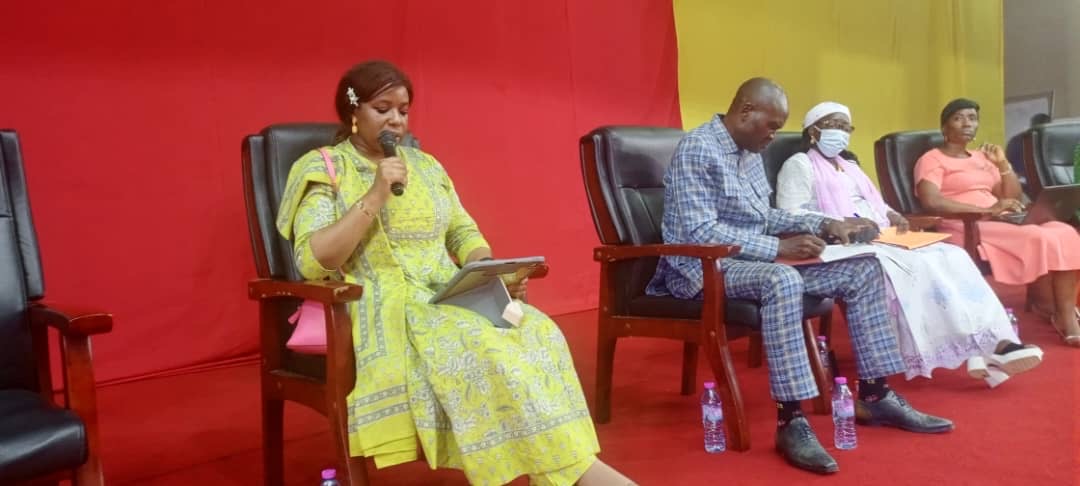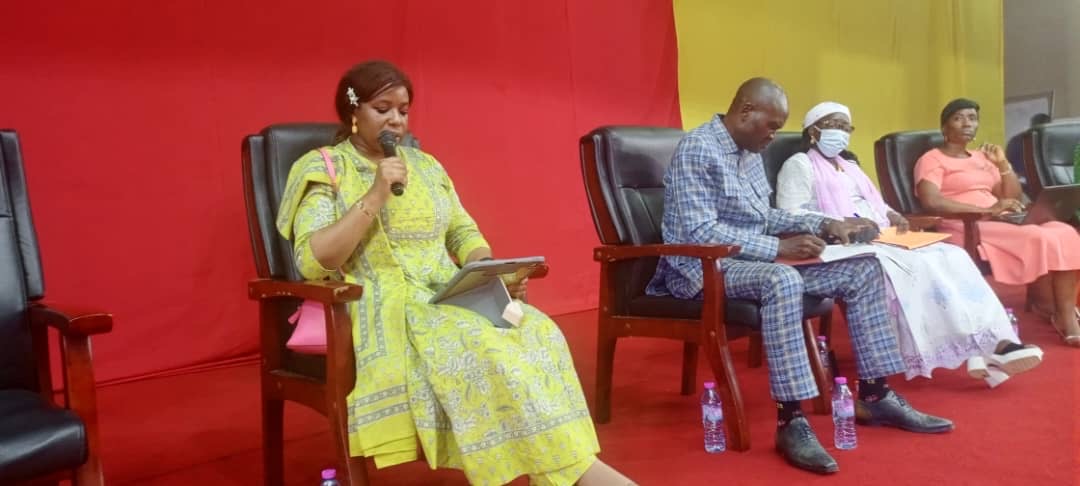
Moderator: Mr. NKO’O ZEH Valère, IAP 1 at the Ministry of Youth and Civic Education
Panel 5 of the Conference was devoted to the theme of National Integration and Citizen Participation, a fundamental axis of youth policy aimed at strengthening social cohesion, collective identity, and active citizenship.
The session was moderated by Mr. NKO’O ZEH Valère, IAP 1 at the Ministry of Youth and Civic Education, who set the tone for the discussions by highlighting the strategic importance of youth engagement in the consolidation of national unity and democratic life.
In his opening remarks, the Moderator emphasized that national integration and citizen participation are not abstract notions, but daily practices that must be nurtured through institutional mechanisms, associative life, popular education, and structured youth movements.
The Directorate of Associative Life and Youth Participation
The first presentation was delivered by Rahmatou Sadjo, who introduced the Directorate of Associative Life and Youth Participation, a structure that constitutes the backbone of youth movements and associations in Cameroon.
She explained that this Directorate plays a central role in organizing, supervising, and empowering youth associations across the country. It also oversees the multiple decentralized structures that ensure grassroots participation, notably the Youth Municipal Councils (CMJ) and Youth Regional Councils (CRJ).
She highlighted that these platforms allow young people to learn democratic practices, leadership, collective decision-making, and community responsibility.
“Youth participation must not be symbolic; it must be structured, sustained, and impactful,” she stressed.
The National Youth Council of Cameroon (CNJC)
The session continued with the intervention of FADIMATOU IYAWA OUSMANOU, National President of the National Youth Council of Cameroon (CNJC).
In her address, she described the CNJC as a relay between young people and public authorities, ensuring that youth concerns, expectations, and proposals are conveyed to decision-makers.
“The National Youth Council is the voice of young people within the institutional framework,” she declared.
She further announced the upcoming National Youth Camp, which she described as a major national event aimed at strengthening leadership, patriotism, and interregional solidarity among young people.
She emphasized that such platforms are essential for nurturing a new generation of responsible and engaged citizens.
The National Council of Popular Education (CONEP)
Another important contribution came from Fidèle DJEBBA, National President of the National Council of Popular Education (CONEP).
She situated the action of CONEP within a context marked by a growing rise in incivility and social disconnection.
“CONEP intervenes in a context of increasing incivility in Cameroon,” she stated.
She clarified the concept of popular education, explaining that it refers to all forms of learning that occur outside the formal school system.
According to her, popular education is not limited by age and is a collective responsibility.
“Popular education has no age limit. It is everyone’s business,” she emphasized.
She described CONEP as a young but ambitious structure, whose mission is to rebuild civic values, social responsibility, and community solidarity.
The International Award for Young People (The Duke of Edinburgh’s Award)
The final presentation of Panel 5 was delivered by Nicole MUNGE ÉPIÉ, Director of the International Award for Young People programme, commonly known as the Duke of Edinburgh’s Award.
She explained that this is a personal and community development programme for young people aged 14 to 24, designed to encourage volunteerism, leadership, discipline, and self-improvement.
The programme is structured around four main areas:
-
Service to others (Altruism)
-
Expedition and Exploration (Adventure)
-
Skills development (Aptitudes)
-
Physical recreation (Sports and leisure)
Participants progress through three levels: Bronze, Silver, and Gold, each corresponding to increasing levels of commitment and achievement.
She highlighted that the international recognition awarded to participants opens doors to educational opportunities, scholarships, and international mobility.
“This programme does not only reward performance; it builds character, responsibility, and global citizenship,” she noted.