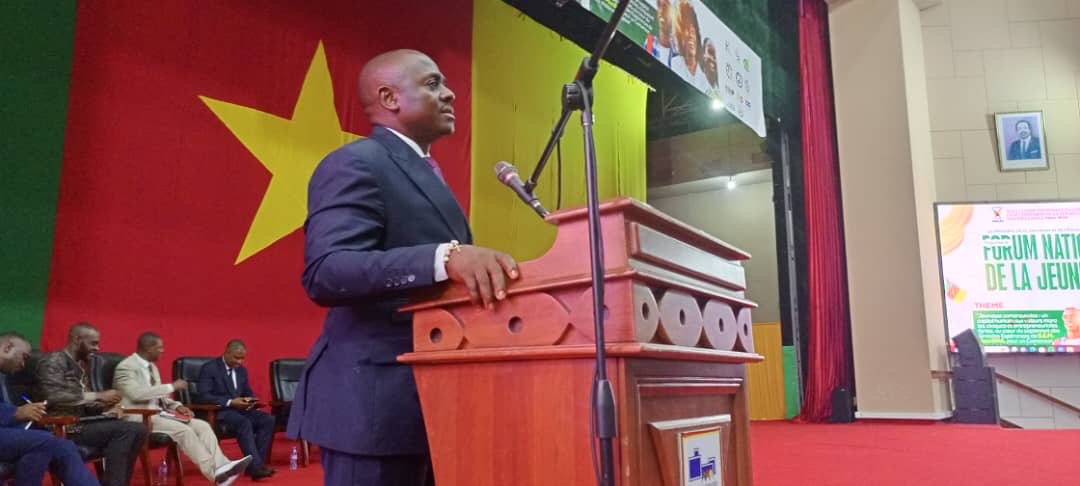
Moderator: Dr. AKEDE METOUGUE Eric (IGS)
Rapporteurs: Mr. FOKA (CG 283) and Mr. TABOUH (C/IGS)
Panel 6 was devoted to the theme of Governance and Institutional Support, a strategic pillar aimed at strengthening the Ministry’s internal control mechanisms, institutional performance, legal security, pedagogical governance, and service delivery.
Moderated by Dr. AKEDE METOUGUE Eric, Inspector General of Services (IGS), this panel provided a platform for key technical structures of the Ministry to present their mandates, achievements, challenges, and reform perspectives.
The Inspectorate General of Services (IGS)
The first presentation was delivered by BAGO Frédéric, Inspector of Services No. 2, who introduced the Inspectorate General of Services.
He explained that the IGS plays the role of the Ministry’s internal watchdog, ensuring compliance, transparency, accountability, and performance.
In practical terms, the IGS:
-
Monitors the proper functioning of Technical and Operational Units (UTO),
-
Conducts administrative audits and inspections,
-
Identifies dysfunctions and irregularities,
-
Applies sanctions to recurrent offenders.
“The Inspectorate General of Services is the gendarme of the Ministry,” he stated, emphasizing its role in maintaining discipline, integrity, and institutional credibility.
The Inspectorate General of Programmes and Teaching and Training Methods (IGPMEF)
The next presentation focused on the Inspectorate General of Programmes and Teaching and Training Methods (IGPMEF).
This structure is a key technical organ responsible for the design, evaluation, and pedagogical steering of youth and civic education programmes.
The following core missions were highlighted:
-
Curriculum design: Defining pedagogical orientations and training content.
-
Evaluation: Assessing reforms, teaching quality, and training outcomes.
-
Pedagogical steering: Ensuring coherence, relevance, and effectiveness of learning methods, particularly in civic education and volunteering.
This synthesis was drawn from the presentation of Paschal KUM AWAH, Inspector General of Programmes and Teaching and Training Methods.
The IGPMEF ensures that educational content remains aligned with national objectives of citizenship, national integration, and youth empowerment.
The Directorate of General Affairs
The Directorate of General Affairs was presented by FIRIDA FALAINA épse HARA.
She explained that this Directorate is primarily responsible for human resource management within the Ministry, using strategic tools such as job mapping.
She also introduced the AIGLES digital platform, which is used for salary and personnel management, explaining how staff can create accounts and track their administrative files.
Other aspects addressed included:
-
The management of family allowance files,
-
The Mutual Insurance Scheme for MINJEC staff,
-
The mobilization of non-tax revenues.
These revenues are mainly derived from:
-
Registration fees in CMPJs,
-
Issuance and renewal of the Biometric Youth Card,
-
Rental of Ministry equipment and facilities.
“Many of our resources have fallen into forfeiture, and this is not our fault,” she indicated.
She also mentioned challenges linked to youth organization subsidies, noting that several decisions had already been validated and were awaiting payment.
The Division of Legal Affairs
The presentation by Dr. MANGA Manfred, Head of the Division of Legal Affairs, focused on the legal safeguarding of the Ministry’s actions.
He explained that the Division’s core mission is to preserve the Ministry’s interests in matters related to youth, civic education, and national integration.
This includes:
-
Ensuring the legality and regularity of administrative acts,
-
Securing the Ministry’s assets,
-
Providing legal advice.
In terms of perspectives, he announced:
-
The establishment of an activity dedicated to the promotion and protection of youth rights,
-
The signing of a Memorandum of Understanding between MINJEC and the National Commission on Human Rights.
CENAJES of Kribi
Victorine NCHIA Kelly, Director of the CENAJES of Kribi, presented the institution’s evolving role.
She explained that while the Centre traditionally trains middle-level youth and animation officers, it has now expanded its scope to other social groups.
New training areas include:
-
Entrepreneurship,
-
Sustainable development,
-
Youth leadership.
She also announced reforms aimed at revising the curricula in order to better align them with the Ministry’s new strategic framework.
The National Civic Service Agency for Participation in Development (ASCNPD)
The presentation by Halidou SADJO, Head of the Department of Mobilization and Training at the ASCNPD, focused on the centrality of values in youth development.
He explained that the Agency’s mission is to mobilize energies for development in all its dimensions.
Three operational mechanisms were highlighted:
-
Mandatory Service (for youth aged 17–21),
-
Voluntary Service Period,
-
Post-Training Service.
He also distinguished between:
-
Pioneer volunteers,
-
Production volunteers,
-
Skills valorization volunteers.
Values, discipline, and service were presented as the foundations of national development.
Challenges in the Implementation of Youth Projects and Programmes
The final segment of the panel focused on field-level challenges, presented by Terrestra NANG, Regional Delegate of Youth and Civic Education for the Littoral.
He stressed that MINJEC must pay greater attention to the profiles and working conditions of Sub-divisional Officers, whom he described as the Ministry’s frontline representatives.
“MINJEC must be concerned about the profile and the working tools of its frontline actors,” he declared.
He called for:
-
Increased training workshops and seminars,
-
Strengthening of pedagogical and disciplinary inspections,
-
Systematic creation of EMPAUR structures,
-
Better personnel deployment at the sub-divisional level.
“We need people in the subdivisions,” he insisted.
On the mobilization front, he lamented that many young people are left without guidance, particularly due to weak peer mentorship within youth structures.
He proposed that future leadership renewals of youth organs should include a residency requirement within the area of jurisdiction.
Finally, he highlighted persistent challenges related to financial and material resources.